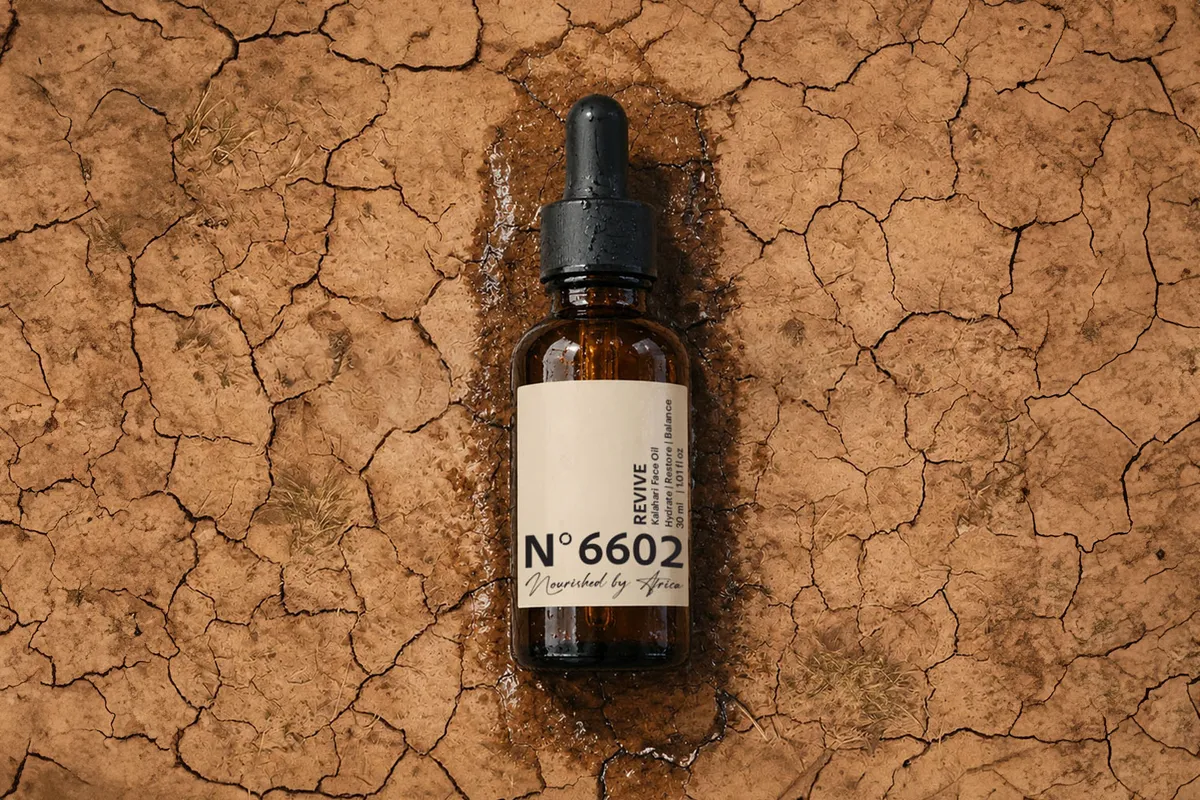
Facial Oil Benefits: Kalahari Melon Seed Oil
What Does Facial Oil Do? The Benefits of Kalahari Melon Seed Oil for Skin
Facial oil is often misunderstood.
Is it simply another moisturiser? Is it suitable for dry skin only? And if you already use a moisturiser or serum, do you really need an oil?
The answer comes down to understanding what a facial oil is actually designed to do.
A well-formulated facial oil provides emollient lipids that help soften and condition the skin, while helping to reduce moisture loss. But not all facial oils are the same. Their fatty-acid composition, texture and formulation can make a significant difference.
At N°6602, that brings us to one of our most interesting South African botanicals: Kalahari Melon Seed Oil.
What does facial oil actually do?
Your skin naturally contains lipids that form an important part of its protective structure.
Facial oils work primarily as emollients. They help soften and smooth the skin and can form a lipid layer at the skin's surface that helps reduce transepidermal water loss.
That is an important distinction.
Oil is not the same as water.
A facial oil does not simply add water to the skin. Instead, it can help condition the skin and support moisture retention.
This is why a facial oil can complement a moisturiser rather than replace it.
For N°6602, the role is simple:
WASH → MIST → REVIVE → RENEW
Cleanse. Refresh. Nourish. Moisturise.
Why Kalahari Melon Seed Oil?
Kalahari Melon Seed Oil comes from Citrullus lanatus, a Southern African melon associated with the dry Kalahari region.
It is a particularly interesting botanical because the plant is adapted to an environment where water is scarce.
But the reason the ingredient interests us is not simply its origin.
It is the oil inside the seed — and, more specifically, its fatty-acid composition.
A peer-reviewed study published in the South African Journal of Botany analysed Kalahari Melon Seed Oil and identified four major fatty acids:
Linoleic acid — 51.4%
Oleic acid — 36.7%
Stearic acid — 6.3%
Palmitic acid — 5.6%
The high proportion of linoleic acid is one of the characteristics that makes the oil particularly interesting for skincare.
Why does linoleic acid matter?
Linoleic acid is an essential omega-6 fatty acid.
It is also naturally present in skin lipids, making the fatty-acid composition of a botanical oil relevant when considering how that oil behaves in a skincare formulation.
The Kalahari Melon Seed Oil analysed in the South African study contained 51.4% linoleic acid, making it the dominant fatty acid in the tested oil.
This doesn't mean that linoleic acid alone explains every effect of the oil. Plant oils are complex mixtures of fatty acids and other naturally occurring compounds.
But it does help explain why Kalahari Melon Seed Oil is such an interesting ingredient for a facial oil designed to feel nourishing without relying on a particularly heavy oil profile.
There is South African research behind it
Kalahari Melon Seed Oil is not simply an exotic ingredient chosen because it sounds interesting.
In 2017, researchers published a clinical assessment of Citrullus lanatus seed oil in the South African Journal of Botany.
The study involved 20 healthy adult women and assessed topical application using measurements including transepidermal water loss, skin hydration and occlusivity.
The researchers reported that the oil was non-irritating in the study population, with instrumental measurements showing reduced transepidermal water loss and increased moisture retention following application.
That gives the ingredient story a useful scientific foundation.
It also illustrates an important point about skincare:
Maintaining moisture isn't only about adding water. It is also about helping the skin retain it.
Kalahari Melon Seed Oil vs other facial oils
Not all facial oils behave in exactly the same way.
Jojoba, rosehip, marula, argan and Kalahari Melon Seed Oil all have different compositions. Their proportions of fatty acids and other naturally occurring compounds influence how they feel, spread and perform within a formulation.
There is therefore no single "best" facial oil for everyone.
The interesting question is:
Why was this particular oil chosen for this particular formula?
For REVIVE, Kalahari Melon Seed Oil brings a distinctive combination of Southern African provenance, a high linoleic-acid content and a lightweight, conditioning character.
That makes it a natural fit for a botanical facial oil designed to nourish without feeling unnecessarily heavy.
What are the benefits of using a facial oil?
A well-formulated facial oil can provide several useful functions within a skincare routine.
Softens and conditions the skin
Plant oils provide emollient lipids that help leave skin feeling smoother, softer and more conditioned.
Helps reduce moisture loss
Facial oils can form a lipid layer at the skin's surface that helps reduce water loss.
In the clinical study of Kalahari Melon Seed Oil, topical application was associated with reduced transepidermal water loss and increased moisture retention.
Adds botanical nourishment
Different botanical oils provide different fatty-acid profiles and sensory characteristics.
This allows formulators to select oils according to the desired skin feel and function of the finished product.
Makes a routine feel more complete
A few drops of facial oil can add a simple conditioning step without turning skincare into a complicated ten-product routine.
And that is important to us at N°6602.
Simple does not mean basic.
Is facial oil good for dry skin?
Facial oils can be particularly appealing when skin feels dry, tight or uncomfortable because they provide emollient lipids and can help reduce moisture loss.
But again, oil and water perform different roles.
A facial oil does not replace hydration.
This is why oils can work particularly well alongside a moisturiser that contains ingredients designed to hydrate and condition the skin.
Think of the routine as complementary rather than competitive:
Hydrate. Condition. Moisturise.
What about oily or combination skin?
The word "oil" can make anyone with oily or combination skin hesitate.
But the fact that something is an oil does not tell you everything about how it will feel on the skin.
The type of oil, its fatty-acid profile, concentration and the finished formulation all matter.
Kalahari Melon Seed Oil is interesting in this context because of its fatty-acid composition and relatively lightweight character.
That said, every person's skin is different. No facial oil should be assumed to be universally suitable for every skin type or condition.
How do you use facial oil?
Facial oil is best thought of as one step within a routine.
A simple approach is:
1. Cleanse
Start with clean skin using a gentle cleanser.
2. Mist
Apply your facial mist or toner if it forms part of your routine.
3. Apply facial oil
Use a few drops and gently press or massage the oil over the face and neck.
4. Moisturise
Finish with your moisturiser if your skin benefits from the additional moisture and conditioning step.
The amount matters.
You do not need to saturate the skin in oil. A few drops can be enough to provide the desired conditioning effect.
Face oil or serum: do you need both?
This is where facial oil and serum are often confused.
A serum is a product category rather than a single type of formula. Serums can be water-based, oil-based or emulsions, and they can be formulated around particular cosmetic ingredients or skin concerns.
A facial oil, by contrast, is predominantly oil-based and is generally used for its emollient and conditioning properties.
You can use both.
But you do not have to.
If you are building a simple skincare routine, the better question is not:
"How many products should I use?"
It is:
"What does each product add?"
For N°6602, REVIVE provides the botanical oil step.
Meet REVIVE
REVIVE — Botanical Face Oil brings Kalahari Melon Seed Oil into a modern, uncomplicated skincare formula.
The focus is straightforward:
Botanical nourishment. A comfortable skin feel. A simple daily ritual.
Kalahari Melon Seed Oil sits at the centre of the ingredient story — a distinctly Southern African botanical with a documented fatty-acid profile and published research investigating its topical moisturising and skin-conditioning properties.
It is precisely the kind of ingredient that reflects what N°6602 stands for:
Rooted in South African Botanicals. Refined by Science.
Where does facial oil fit into a simple skincare routine?
You do not need ten steps to care for your skin.
A considered routine can be remarkably simple:
WASH — cleanse
MIST — refresh
REVIVE — nourish
RENEW — moisturise
Each product has a purpose.
Nothing is there simply to make the routine longer.
If you want to understand how the four steps work together, read The Complete Simple Skincare Routine.
And if you are looking for a botanical facial oil with a distinctly South African ingredient story, discover REVIVE – Kalahari Face Oil | Hydrate | Restore | Balance
N°6602 — Nourished by Africa.
